
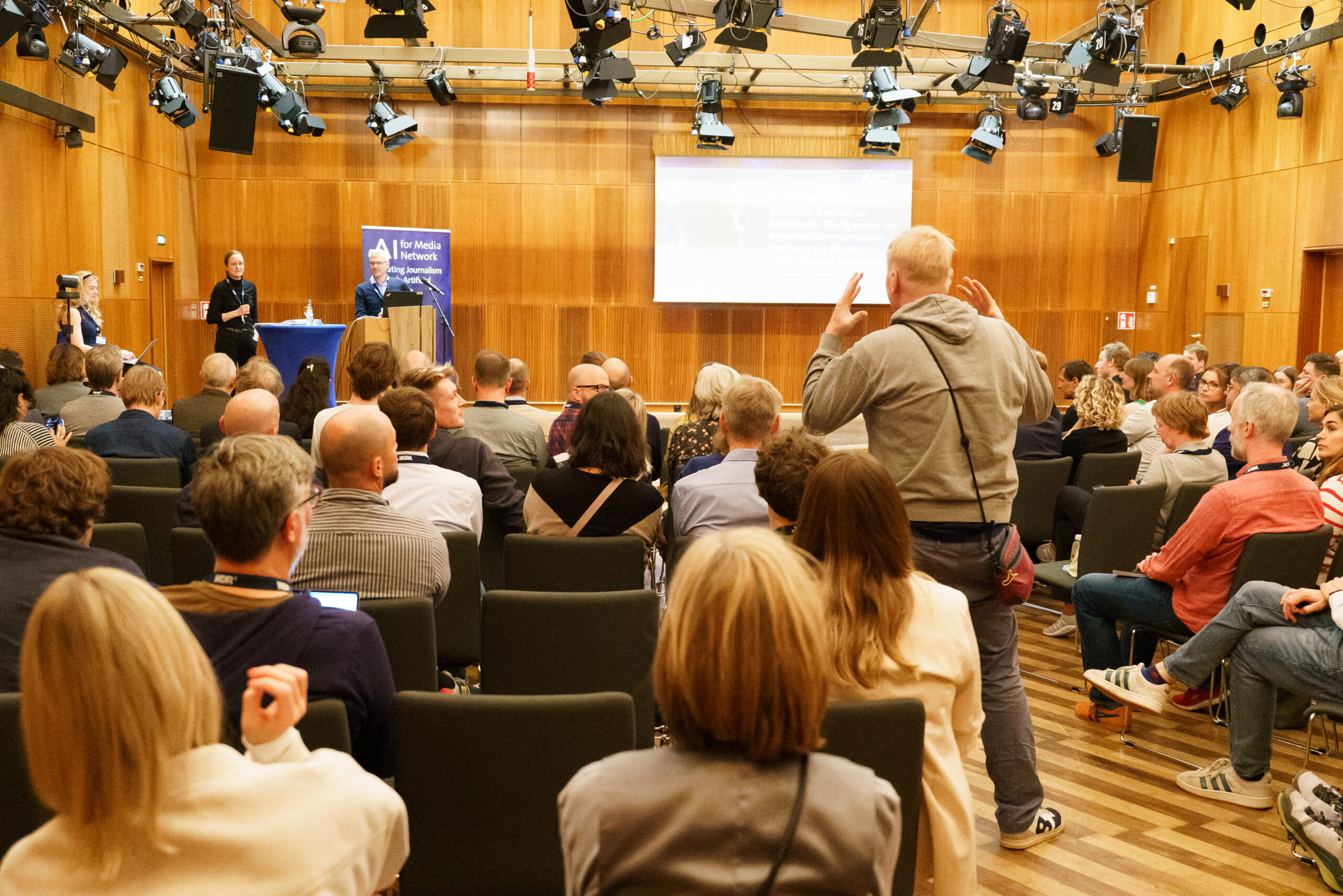
At the 5th AI for Media Meetup, the focus was on how newsrooms use RAG systems to make their content ‘addressable.’ This is particularly aimed at users, but also partially beneficial for the newsrooms themselves. Here we present the different use cases.
“Conversational Journalism with RAG Systems’ was the theme of the 5th Meetup of the AI for Media Network, held on September 25th, 2025, at the WDR broadcasting house in Cologne.
WDR Director Dr. Katrin Vernau opened the meetup with a video-transmitted greeting: „Conversational Journalism with RAG Systems, a challenging but highly relevant topic,“ she said. Vernau emphasized the importance of representatives from private and public media, as well as science and technology, coming together in the AI for Media Network. She highlighted the opportunities associated with the impending changes through AI in the media landscape, such as changes in user interaction and increased efficiency, but also pointed out associated risks, such as the hallucination of chatbots.
Agents as Independent Actors in Journalism
Christiana Elmer, Professor of Digital Journalism and Data Journalism at TU Dortmund, kicken off the lecture series with a keynote on the role of AI agents as new actors in the journalistic network. She emphasized that there are two major themes in the field of AI and media: RAG and AI agents, which act not only as tools but as technological actors in the network. Her guiding question was: “How do we manage to think about journalism agent-centered without playing telephone with the agents?” It is crucial to consider the needs and requirements of AI agents. This development requires a fundamental transformation in content design, infrastructure, and interfaces, as well as a critical examination of AI systems for potential biases.
Introduction to the Functionality of RAG Systems
Franziska Hellmundt, AI project manager at WDR, provided an insightful explanation of RAG systems and their functionality She walked through the process of vectorizing content to enable effective searching by RAG systems. She emphasized that RAGs should not be viewed as a ‘ panacea, ‘ as the lack of iterative thinking ability still poses a major challenge.
The BreznBot: Joint Content Pool of BR and Ippen Digital
In a collaborative presentation, Ulrike Köppen, Chief AI Officer of Bayerischer Rundfunk (BR), and Cécile Schneider, Product Lead of the AI + Automation Lab at BR, explained why BR and Ippen Digital developed a joint product: The BreznBot answers user questions about the Munich Oktoberfest based on Oktoberfest-specific content from BR and Ippen. This RAG system is an example of a “Trusted Content Pool,” i.e., high-quality content from various trusted sources (content from oktoberfest.de was also used for the project). With the development of the BreznBot, BR and Ippen want to encourage further content partnerships between public and private media houses. One fascinating insight was the diversity of questions posed: ranging from service-oriented queries like: “Where can I ride a carousel as a wheelchair user?” to news-focused inquiries such as “Were there any incidents today?” Schneider highlighted the substantial editorial effort required for such a chatbot, noting the considerable work involved in securing its technical infrastructure against external threats.
“What Does It Matter to Me?” – Explaining Laws with AI
WDR has developed an AI application that helps analyze complex and often lengthy legal texts, making them easily digestible for the average person. Stefan Domke, project manager at WDR, and David Finsterwald, freelance developer and consultant, presented the project “What Does It Matter to Me?” in a live demonstration. Domke demonstrated through live voice input how the chatbot answers user-oriented questions about the ‘Bauturbo, ‘ for example, the impact of the law on one’s grandmother. Users can also converse with the bot in other languages, such as Turkish.
BNN: From Hackathon Idea to own RAG System
Subsequently, Nico Hehlke and Ole Fehling presented the DRIVE initiative, a collaboration of 30 regional publishers from the DACH region. Among these is the Badische Neueste Nachrichten (BNN), for which DRIVE has developed a RAG system. Julius Sandmann, AI Manager at BNN, shared a specific newsroom use case: Reporting on the renovation of Kaiserstraße in Karlsruhe, where there is constantly a new status of the construction work. BNN employees use the RAG to create up-to-date background paragraphs on the history of the construction site. The BNN-RAG crafts these paragraphs using the vectorized BNN archive, exemplifying how the system significantly alleviates the editorial workload on a daily basis, Sandmann noted.
Sandmann had already played through this use case at the first AI for Media Hackathon in 2024. At that time, Sandmann belonged to the “Accio” team, which won the hackathon with the idea of efficiently pulling relevant articles from their own archive on a topic that frequently has updates.
Dpa Wants to Provide Information More Efficiently with RAG Through “Push” and “Pull”
Also in the ‘Research Assistant, ‘ the RAG system of the news agency dpa, archive material plays a major role. Yannick Franke, head of the AI team at dpa, said the agency wants to create new distribution channels for its content with this RAG system. So far, dpa’s business model has been to produce content and push it to their customers, precisely by sending notifications. The Research Assistant now marks the transition to the “pull principle”: Customers can ask specific questions to the RAG fed with archive material and receive tailored answers.
As is tradition, the meetup concluded with the ‘AI Spotlight’ segment, offering audience members the opportunity to showcase their latest AI projects and innovative ideas.
Stefan Voss from dpa presented the monthly meeting of his AI trainer group for journalists by journalists. Julia Lüke from WDR Userlab presented the AI Bank.
In this segment, participants have the chance to interact with AI-powered avatars, crafted from extensive conversations with individuals from underrepresented groups within the WDR broadcast area.
Wilfried Runde from Deutsche Welle introduced the ‘Chat-Europe’ chatbot, a collaborative creation with dpa, designed to fully leverage European technology—specifically the Mistral language model—to ensure autonomy from non-European LLM models. Concluding the session, Fabian Lang, AI Engineer at Deutsche Welle, showcased the “Constructive News” newsletter, an AI-generated publication that offers constructive reporting on global events, with its content meticulously reviewed by editors following the ‘Human-in-the-loop’ approach.
Video Recording and Presentations
Members of the AI for Media Network can find the recording and presentations on this password-protected page.
The 5th Meetup marked the first gathering outside Munich, with nearly 100 guests on-site and over 100 participants online at times. The high demand for in-person spots shows that the AI for Media Meetup is well-received outside of Munich. In the future, the event will be alternately hosted in Munich and other cities.
Next Meetup on November 18th at Media Lab Bayern
The next Meetup of the AI for Media Network will take place on November 18th at Media Lab Bayern in Munich. The topic will be “AI in Regional Journalism.” If you would like to suggest a speaker or nominate yourself as a speaker, you can reach us at: aiformedia@br.de
To stay informed about all the news and events of the AI for Media Network, you can subscribe to our newsletter here.