
Scaling, transforming, creating new distribution channels: Just three examples of how regional media use AI. Here’s an overview of all the use cases from the 6th AI for Media Meetup.
The 6th AI for Media Meetup took place on November 18, 2025, at the Media Lab Bayern, under the theme “AI in Regional Journalism.”
AI as a Colleague
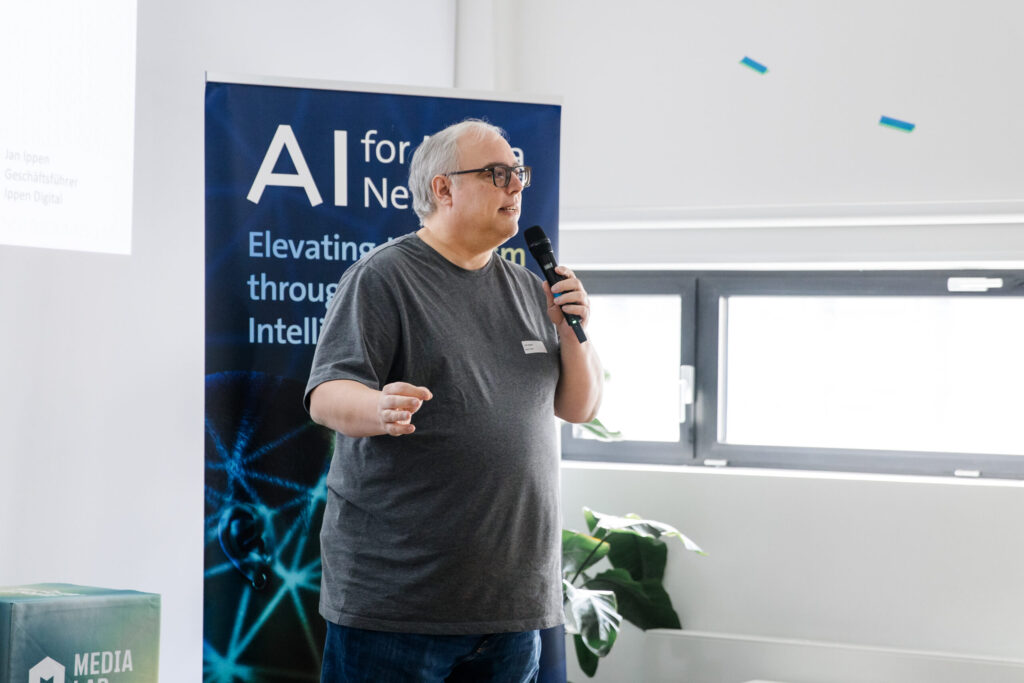
In his keynote “The Role of Humans in the Age of AI,” Jan Ippen, CEO of Ippen Digital, presented three key concepts: “Human in the Loop,” “Human on the Loop,” and “Human Autonomy Teaming.” Each concept increases the level of autonomy granted to AI. While “Human in the Loop” emphasizes human control, “Human on the Loop” allows more freedom for AI. Finally, “Human Autonomy Teaming” includes AI as an equal team member. Ippen Digital’s “Local Event Radar” is an example of “Human Autonomy Teaming.” Here, AI and humans work together as a real team: the AI crawls for relevant information and summarizes it, while journalists evaluate, prioritize, and handle publication.
Scaling with AI: Election Result Articles for Each Community
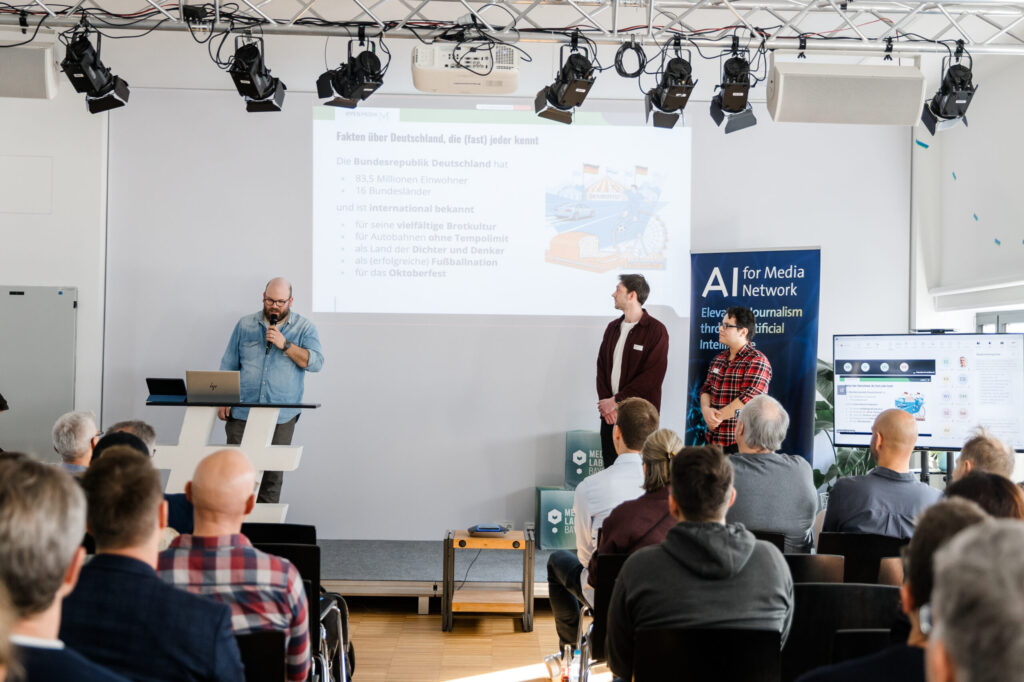
The second presentation also came from Ippen Digital: The publisher uses AI to expand its (hyper)local reporting. Patrick Kuolt, Head of Local AI, demonstrated how Ippen published fully AI-generated articles on mayoral and municipal elections — fully automated. His colleague Niklas Kobelev explained how the pipeline works with steps like generating, validating, enriching, improving, and formatting. Gianmarco Luongo, Local AI Specialist, presented the use case of “tz Wiesn Madl,” a beauty contest receiving numerous application texts. The team created AI workflows via make.com, which transformed these texts into online articles within about only five minutes.
From Text to Sound: AI Gives Local Journalism a Voice
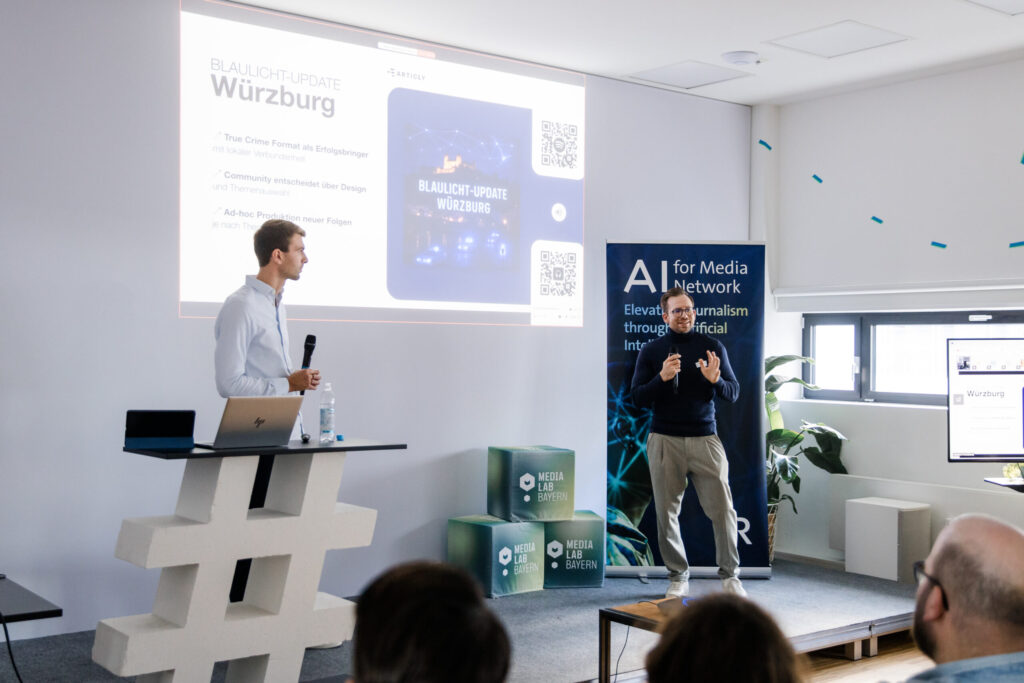
Wolf Weimer, founder of Articly, showcased how his startup converts journalistic texts like articles, newsletters, or RSS feeds into audio formats such as podcasts or WhatsApp voice messages. Local editorial teams set the desired tone (e.g., detailed, humorous, or analytical) and specific parameters for the audio format. LLMs then create an audio-optimized podcast script, which undergoes multiple checks: first, a fact-checking agent reviews the script for accuracy, then it’s compared multiple times with the original article to ensure every fact is present before being submitted for editorial approval. The approved text is then converted into an audio file by a text-to-speech model. This workflow is used, for example, by the media group Main-Post for their podcast “Blaulicht-Update Würzburg,” created with Articly.
Christian Papay, Head of Innovations at the media group Main-Post, reported that the Main-Post’s Blaulicht Facebook community was involved in developing the format. The community provides feedback after each episode: Is the episode length appropriate? Are the AI voices acceptable? The project is still in the pilot phase, with Main-Post aiming for 200 subscribers, 2000 views, and at least one advertiser.
Bot Enables Chat with RP’s Gastro Content
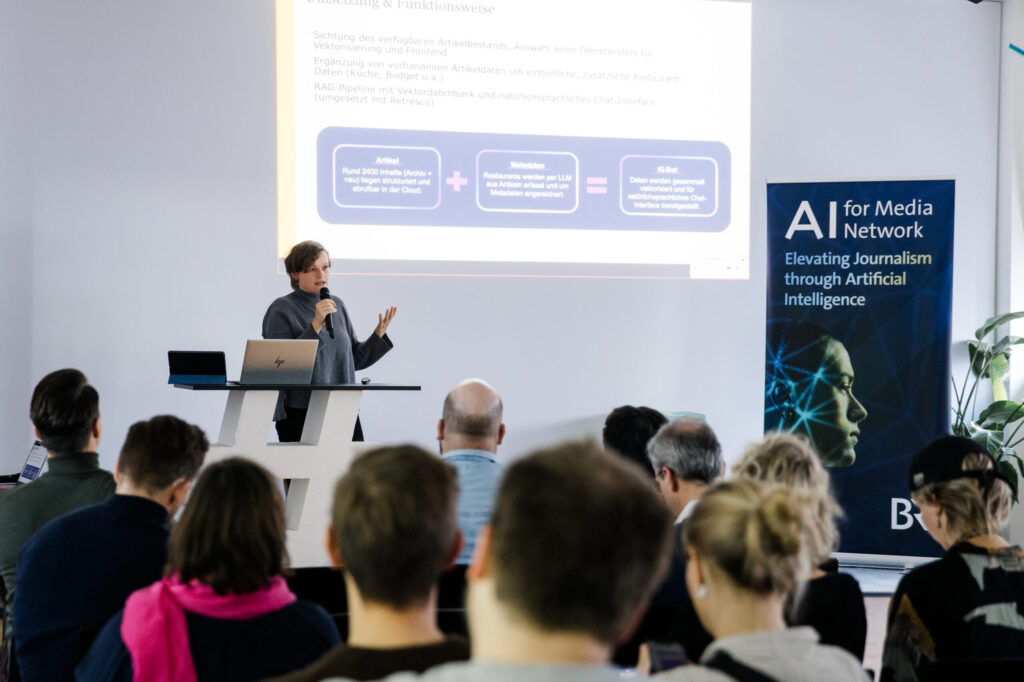
Johanna Heinz, journalist and project manager at Generalanzeiger in Bonn, presented the Gastro-Bot, which makes the Rheinische Post media group’s restaurant recommendations accessible in an interactive way. The bot focuses on “quality over quantity” by recommending only venues that have already been covered editorially. The Gastro-Bot is a RAG application: approximately 2400 gastro articles are structured, enriched with metadata, and vectorized in the cloud. When users inquire about a restaurant in the chat interface, the vector database is searched and the results are included in the response.
According to Heinz, the biggest challenges are keeping the data up-to-date and meeting users’ high expectations for the completeness and accuracy of the responses. The Gastro-Bot, available in its beta version since September, is set to be expanded to more media houses by the end of the year.
SZ aims to attract new readers with local WhatsApp groups
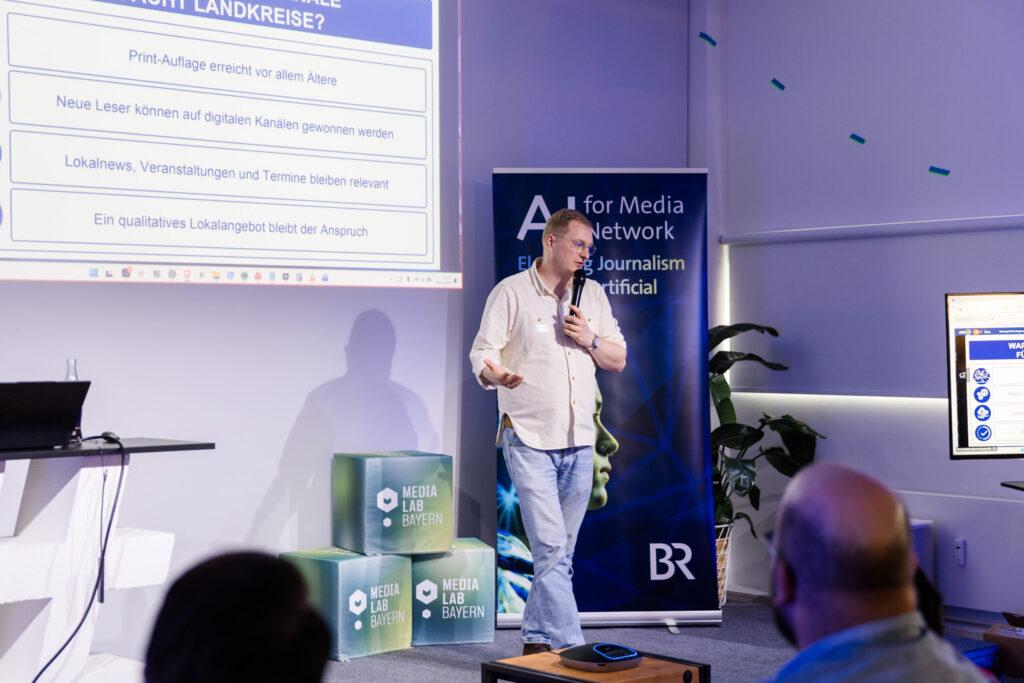
The Süddeutsche Zeitung recently launched WhatsApp channels for the eight districts surrounding Munich. The content for these channels is suggested by a suggestion engine from the service provider BeatSquares. According to CEO René Bosch, the tool collects news from various sources—articles from the Süddeutsche Zeitung, announcements from authorities, and event notices—and filters out irrelevant content. Next, a fact engine checks the facts in the texts. Journalists decide which articles are ultimately published in the WhatsApp channel, which is very important to SZ. Bosch quoted Isabel Bernstein, head of the desk team for Munich, Region, and Bavaria at the Süddeutsche Zeitung: “In our project, AI has the first word, but the editorial team has the last.” Within three weeks, SZ gained 7,000 subscribers with its eight local WhatsApp channels.
New Format: Problem Pitch
Our newest format, the “Problem Pitch,” aims to provide media professionals with a platform to present a problem from their own media house and leverage the collective intelligence of attendees to gather solutions.
Translate News Broadcast from Swiss German to English
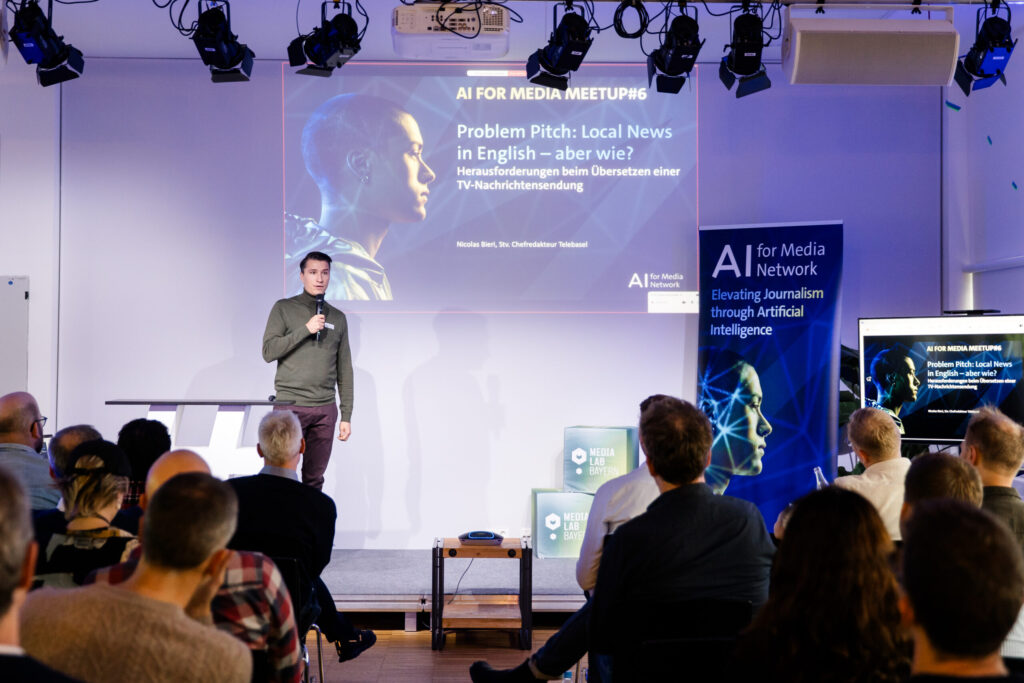
The TV station TeleBasel produces the news program “Punkt 6” in Swiss German. For the international community in Basel, which comprises around 40,000 people, TeleBasel aims to create an English version of the program. Although AI features like voice cloning and lipsync can translate the voices of speakers, they are associated with ethical and legal issues, said Deputy Editor-in-Chief Nicolas Bieri. Therefore, classic voice-over must be used. Another challenge is accurately translating dialects, such as Swiss German to English. Additionally, providing the program in English within 2-3 hours poses another challenge.
Anyone with solutions can contact Nicolas Bieri at nicolas.bieri@telebasel.ch.
Scraping Municipal Data
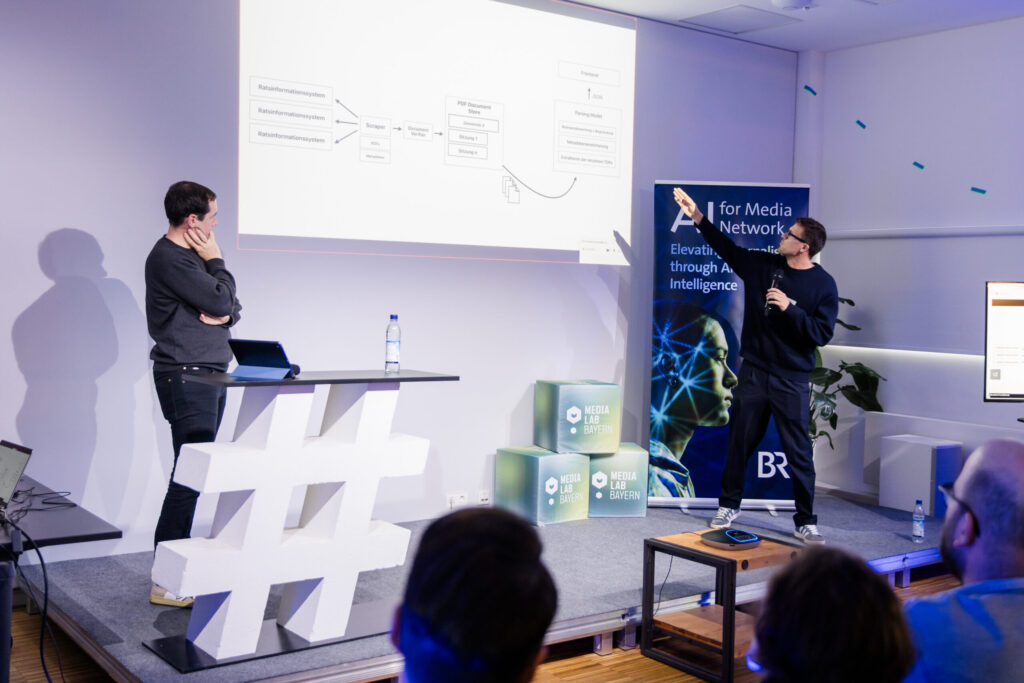
The second Problem Pitch focuses on capturing data from municipal council information systems. Felix Gayer, Head of AI and Automation Hub, and Dr. Jan Georg Plavec, Senior Editor for Data Journalism, presented their project “RatsRadar,” which automatically reads and analyzes PDF documents generated during council meetings to identify topics worth reporting on. Gayer has experimented with agent-based scrapers that work for about 70 percent of the municipalities in the distribution area of the Stuttgarter Zeitung. However, the goal is to achieve 100 percent. “If anyone has experience with consistently scraping these documents using agent-based scraping, we would be very grateful.” Those with solutions can contact Felix Gayer at felix.gayer@n-pg.de and Jan Georg Plavec at jangeorg.plavec@mhs.zgs.de.
Video Recording and Presentations
Members of the AI for Media Network can find the recording and presentations from the “AI in Regional Journalism” meetup on this password-protected page.
Next Meetup on February 12 at Spiegel in Hamburg
The next AI for Media Network meetup will take place on February 12, 2026, at Spiegel in Hamburg. We will soon provide information on the topic and registration options. Those wishing to suggest topics or (keynote) speakers can reach us at: aiformedia@br.de.
Anyone who wants to stay informed about all news and events of the AI for Media Network can subscribe to our newsletter here.