
The AI & Search study by BR and ARD SEO shows how the search for information is changing through AI tools and AI summaries in search engines: The zero-click danger is real. However, there are also some positive findings for news providers.
Since the release of ChatGPT, and especially since the introduction of Google’s “AI Overviews,” there has been unrest in the media industry. In addition to copyright and performance protection issues, the question arises as to the extent to which AI-generated answers discourage users from visiting editorial websites. For public web offerings, this is about visibility and relevance.
A study by BR Media Research in collaboration with ARD SEO examined the role of AI in information search. For the study, the IFAK Institute surveyed 1,200 people aged 16 to 69 in Germany who use the internet in October 2025. The results are representative for this group.
More than 80 percent of respondents have already used AI for information search
82 percent of 16- to 69-year-olds in Germany have already used some form of artificial intelligence (AI tools or AI summaries in search engines) for information search, 61 percent do so regularly (i.e., daily or weekly). AI summaries found in various search engines are part of the at least weekly search routine for 41 percent of respondents.
AI tools like ChatGPT, Google Gemini, or Perplexity are even more widespread, with a weekly user base of 49 percent. It should be noted that the most-used and first tool of its kind, ChatGPT, has been available for just under three years.
AI as a search tool is especially popular among younger people: 87 percent of 16- to 29-year-olds and 72 percent of 30- to 49-year-olds are regular users of AI summaries or AI tools.
Indications of reduced use of editorial offerings due to AI
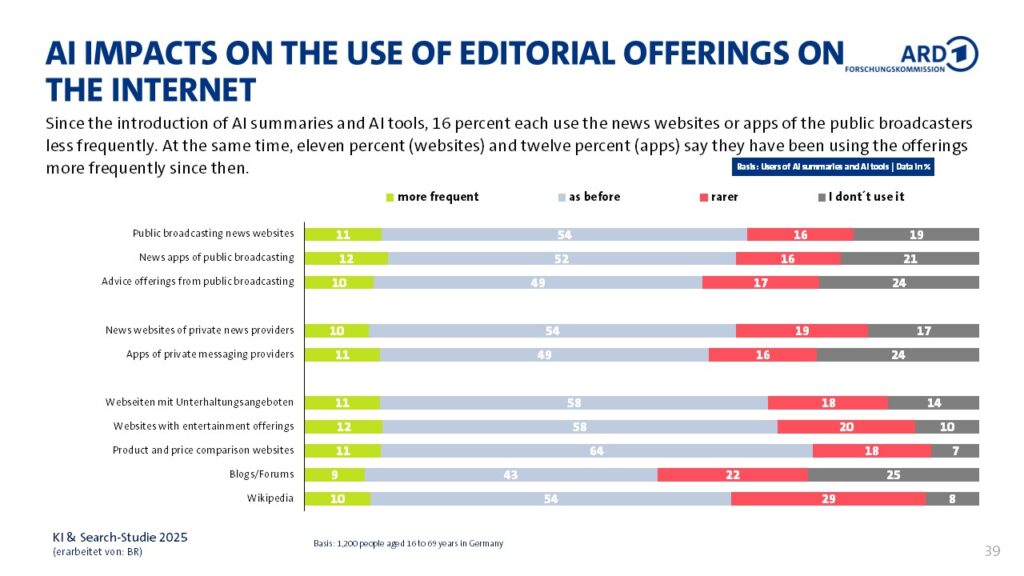
To determine how information search has changed through AI, users of AI tools and AI summaries in search engines (at least rarely; 46% of the total sample) were asked to assess whether they use certain online offerings for information search more or less frequently since the availability of these AI applications. News websites and apps fared relatively well, although there is a slight decline in usage: 11 percent use public broadcasting news websites more frequently, 16 percent use them less frequently. The figures for private news provider websites are almost identical.
The picture is bleaker for blogs, forums, and Wikipedia: Based on the part of their respective user base that uses AI summaries and AI tools at least rarely, they lose about a fifth of their audience.
Zero-click danger is real
To obtain reliable figures on the use or non-use of further links in AI-generated answers, respondents were asked about their online search behavior within the last week. 54 percent of those who encountered AI summaries in search engines during this period clicked on a further link in no more than half of the search processes. The results also indicate that clicks on further links are more likely within the conventional search results list than in the AI summary itself. However, the effect of missing link clicks may be even larger. Among users of AI summaries, 19 percent state that they have not yet noticed any further links in the overviews.
In AI tools, significantly more inquiries end without checking the source: Here, 76 percent of users in the week before the survey say they called up further links in no more than half of the search processes.
In news, users of AI tools are more likely to click on the link to the original source
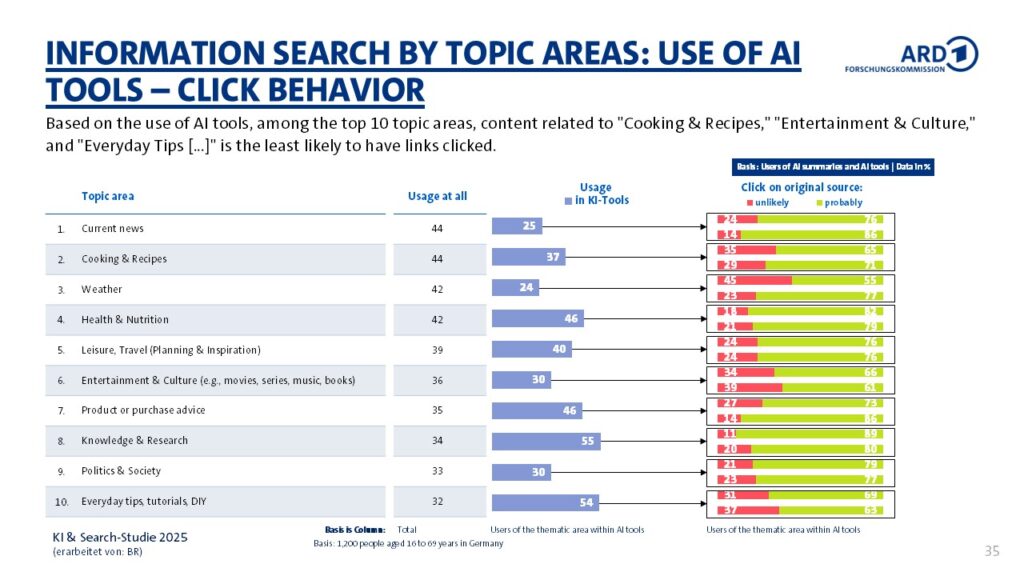
When a further link is clicked and when not also depends on the topic. For current news, it is more likely in both AI tools and AI summaries in search engines than in many other topics that people click on deep links to original sources.
In AI summaries in search engines, links-clicks to original sources are less likely for topics like “weather,” “sports events.” The same applies to entertainment or everyday topics (such as recipes or everyday tips), regardless of whether corresponding content is received via AI summaries in search engines or AI tools.
For “hard topics” such as knowledge & research, health & nutrition, politics & society, and current news, the likelihood that users of AI responses click on the original source is greatest.
High satisfaction with the quality of AI answers, but limited trust
Users generally rate the quality of AI-generated answers in search engines and AI tools predominantly positively. User-friendliness, timeliness, and relevance are particularly highlighted. This positive evaluation by users contrasts with measurements of the quality of AI answers. The EBU study “News Integrity in AI Assistants,” published in October 2025, found that 45 percent of answers from AI tools contain at least one serious error.
High trust in websites and apps of public broadcasting and private media
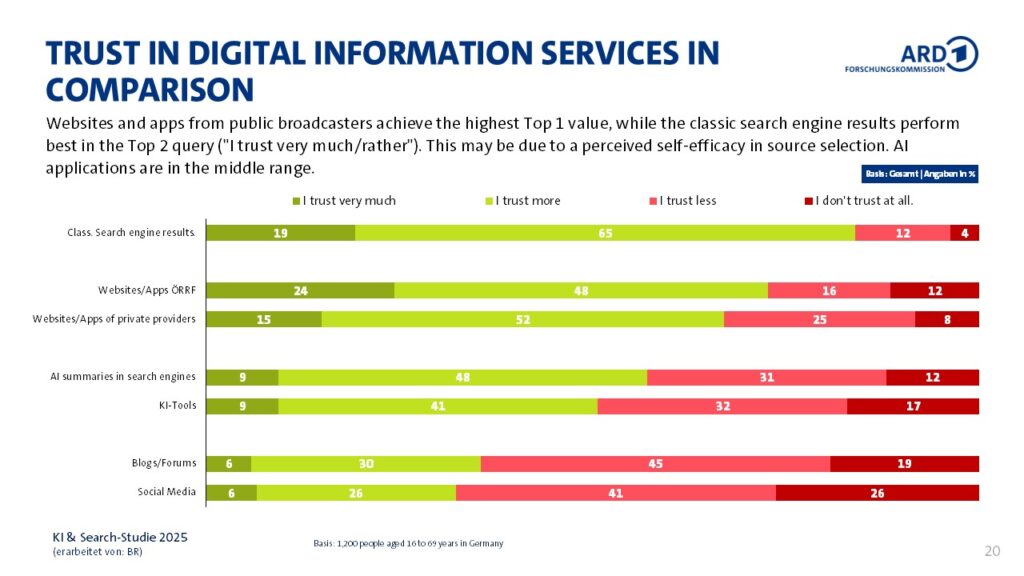
Despite high usage and positive ratings, only slightly more than half trust AI-generated information. The highest trust is enjoyed by classical search engine results with 84 percent (19% trust very much, 65% trust rather). In addition to the intensive everyday integration of Google & Co., a strong sense of self-efficacy of users (self-controlled selection of the final used sources) is likely to contribute to this top ranking. In addition, websites and apps of public broadcasting with 72 percent and private media providers (67 percent) continue to enjoy significantly more trust in information search than AI applications.
This is an important result for established media providers, as the trustworthiness of information is the second most important criterion for users in information search after correctness. It is very or rather important to 92 percent of Germans aged 16 to 69.
Despite the challenges posed by the increasing use of AI tools and AI summaries in search engines, there are encouraging findings for media providers. Firstly, the study shows that interest in news remains high, as users are more willing to click on links to the original source for current topics. This suggests that news brands continue to play an important role despite competition from AI-generated answers.
Secondly, the trustworthiness of news providers, particularly public and private media, remains high. While AI-generated information enjoys only limited trust, users trust classical search engine results as well as the websites and apps of established media significantly more. These factors underscore the continued relevance and importance of editorially designed news offerings and professional SEO activities in the digital information landscape.