
AI is not only transforming the way news is created but also how people consume it. The News Impact Summit “Elevating Journalism with AI” highlighted that reaching Gen Z requires moving away from mere broadcasting and towards co-creation. Furthermore, the use of AI is less about technology and more about trust, context, and attitude.
Every year, the European Journalism Center hosts the News Impact Summit in collaboration with the Google News Initiative. This year’s summit was themed “Elevating Journalism with AI,” aligning perfectly with our focus, which is why the AI for Media Network became a program partner for the conference held on October 9 in Warsaw. Network Manager Bernd Oswald reflects on three of his personal program highlights.
Public Perception of Generative AI in News
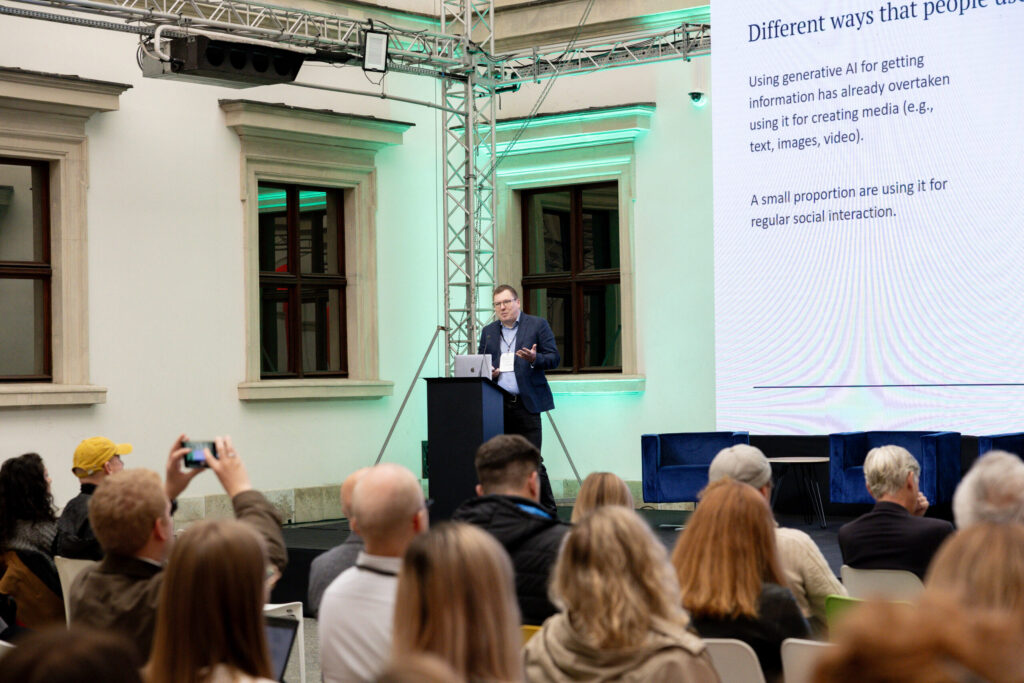
The Reuters Institute for the Study of Journalism at the University of Oxford has explored public opinion on the use of AI in journalism in its new report, “Generative AI and News 2025.” Over 12,000 people were surveyed, with approximately 2,000 participants each from Argentina, Denmark, France, Japan, the United Kingdom, and the United States.
Richard Fletcher, Director of Research at the Reuters Institute, reported that the use of AI tools has doubled within a year, particularly among younger users who employ AI to reformat news into more comprehensible forms. Despite this increase, there remains a notable skepticism towards AI-generated content:
- 62% of respondents prefer news entirely created by humans.
- AI is most accepted “behind the scenes” (e.g., proofreading, translation, data analysis).
- AI is least accepted in visible content creation (e.g., complete texts, realistic images, avatars).
A relative majority believes that generative AI enables media to produce news more cheaply and allows users to stay better up to date. However, respondents also perceive AI-generated news as less trustworthy. Fletcher’s conclusion is that the audience remains cautious about AI’s role in journalism: AI can assist, but the responsibility for the content must remain with journalists. The complete study is available on the Reuters Institute’s website.
JournalismAI Innovation Challenge: How Small Newsrooms Can Effectively Utilize AI
At the AI for Media Network, we often face the question: How can smaller newsrooms apply AI for their purposes without substantial resources? The JournalismAI initiative offers a program specifically for this audience: the JournalismAI Innovation Challenge. In Warsaw, Program Manager Lakshmi Sivadas showcased four projects supported by this program. One example is Gubbi Labs LLP from India, which developed an LLM-based application that transforms scientific articles into compelling stories. (All 35 projects are described on the JournalismAI Innovation Challenge website).

Sivadas presented six key lessons from the program:
- Always start with the problem or need (otherwise there is no point for applying AI)
- Adhere to editorial guidelines and standards while building the AI tools
- Work in interdisciplinary teams and collaborate outside of the industry
- Integrate tools seamlessly for maximum adoption
- Feedback and interation are crucial
- Don’t overlook the human element
Sivadas emphasized that AI doesn’t replace journalists but expands their capabilities. Successful projects begin not with the question “What can AI do?” but with “What does our audience need?”
Gen Z Needs Formats They Can Identify With
In her presentation “Why GenZ Would Rather Talk to News Than Read Your Article,” Ilona Vinogradova, founder of the film production company LovinFilms Pro, analyzed how AI is changing media consumption behaviors and what journalism should do in response, particularly concerning Gen Z engagement.

The success of generative AI like ChatGPT lies in providing users with individualized responses. Vinogradova described AI as a “hyper-personalized storytelling ecosystem.” In contrast, media often still operate under the article principle: static, monolithic content with a “one size fits all” approach. Gen Z, however, demands formats they can identify with. Journalism needs to answer the question ‘So what?’ much more clearly and connect the news to the lived reality of young audiences.”
“Gen Z isn’t abandoning news, They’re abandoning formats that don’t respect their intelligence or desire to participate“, Vinogradova stated. Her advice to journalists: “We should transition from publishers to platforms for a community. Journalism is no longer done for the audience but with the audience.”
Recordings Available Soon on YouTube
Videos of the presentations held on the main stage will be published in the coming days on the European Journalism Centre’s YouTube channel.