
At the 8th “AI for Media” meetup hosted by Bayerischer Rundfunk (BR), the focus was on how vibe coding can bring newsrooms, product management, and engineering closer together – in line with the motto: humans are the head chefs, AI is the sous-chef. Vibe coding makes it possible to build prototypes quickly – but the path to a production-ready product is significantly longer.
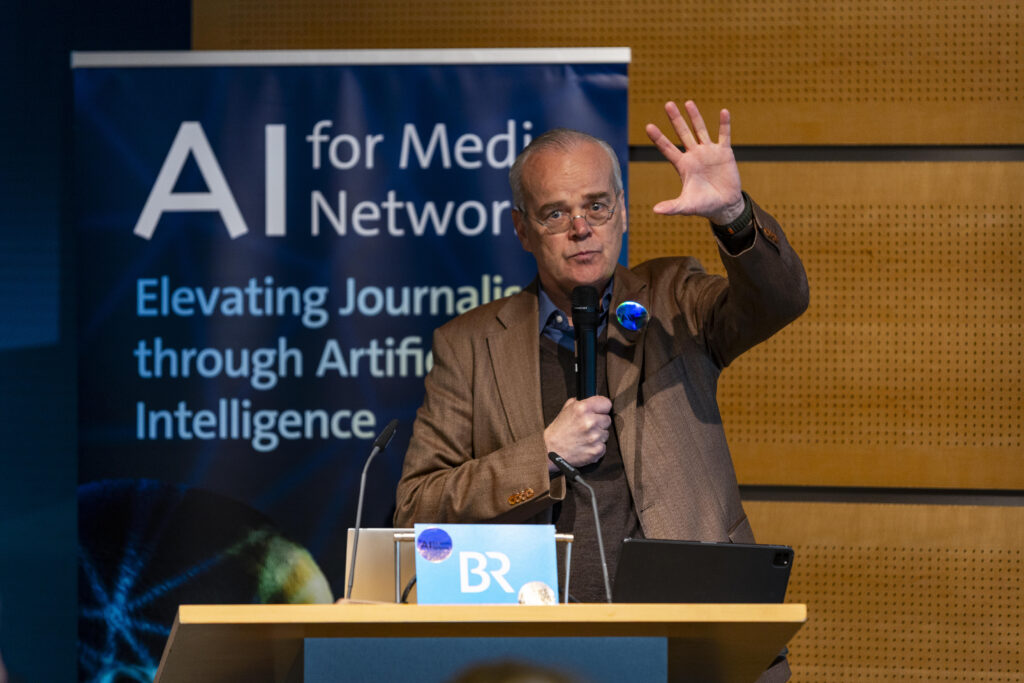
On May 12, 2026, 120 AI experts from editorial, product, engineering, and academia took part in the Vibe Coding meetup of the AI for Media Network, held at the Bayerischer Rundfunk headquarters in Munich.
Vibe coding refers to a way of “programming” in which requirements are described in natural language and a generative AI system turns these descriptions into code, scripts, or even full applications. You don’t need traditional programming skills; instead, you need the ability to describe ideas and problems clearly. The AI then uses these descriptions to, for example, build a prototype.
“Staying Ahead of the Wave”: Why Vibe Coding Is Strategically Important for Media Organizations
In his welcome remarks, BR Director of Information Thomas Hinrichs underscored why this topic is a top management priority at BR: media organizations must “stay ahead of the wave” when it comes to AI developments rather than chasing it. Vibe coding makes it possible to test ideas in hours instead of months – for example, to see whether a new format resonates with audiences.
It’s Not About “Time-to-Prototype,” It’s About “Time-to-Trustworthiness”
Media innovation journalist Ulrike Langer used U.S. examples to show how deeply vibe coding has already penetrated newsrooms there. Andy Sullivan, Washington correspondent for the Reuters news agency, for instance, has built 14 tools using the vibe coding method, despite not being a programmer. His best-known prototype is a bot that scans hundreds of daily entries in the U.S. Federal Register and flags important items for the newsroom. The prototype was built in just a few hours; the real work went into fine-adjustment.
Langer’s conclusion: “Vibe coding lowers development costs, but not the costs for the people at the steering wheel.” It often takes months of testing, quality assurance, and alignment processes to turn an AI-generated prototype into a fully mature product. For Langer, “time-to-prototype” is irrelevant; what matters is “time-to-trustworthiness.” She urged newsrooms to already now define mechanisms for “switching off” vibe coded tools: Who will be responsible in five years when there are hundreds of small helpers in the system, but only a fraction are actually used?
“Can’t AI Do That?”: A Pragmatic Introduction to Vibe Coding
Nils Erich, product manager at BR’s AI + Automation Lab, explained how vibe coding works in day-to-day practice. Successful vibe coding, he argued, depends on four elements: appropriate tools, a mindful mindset, domain expertise (for example, understanding editorial workflows), and the “vibes” – a clear sense of what you want a tool to accomplish. Vibe coding, he said, was particularly useful for rapid prototyping to test hypotheses; for small automations such as Excel functions, bookmarklets for debugging in the CMS, or scrapers for RSS feeds; and for more complex use cases, such as using AI as a learning partner to work through new, complex subject areas.
Erich recommended not starting vibe coding with “writing code,” but with observation: whenever a work step was repetitive or annoying, that was a signal to ask the AI what they could build there. As a first step, he suggested using a system prompt that forced the AI to explain every step, so that people could learn software fundamentals while building their prototype. Anyone who wanted to do sustainable, effective vibe coding needed, above all, a willingness to learn continuously.

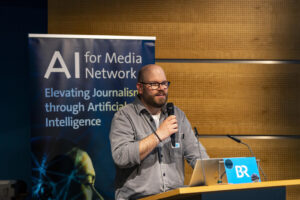


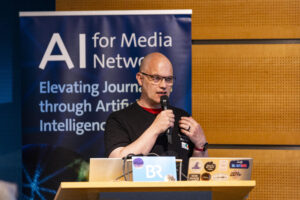

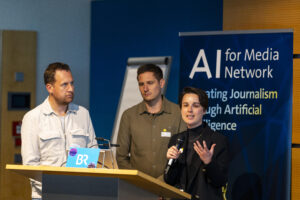
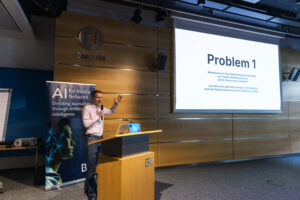
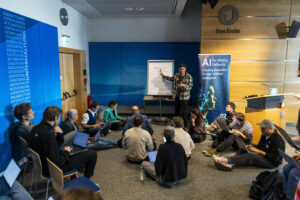
all Photos: Raphael Kast. Additional photos from the Meetup are available at our ARD-ZDF-Filesharing-Platform. Photocredit: Photo: BR/Raphael Kast.
Editorial Guard: A Vibe-Coded Compliance Check Tool on Its Way Into the CMS
Patrick Kuolt, Head of Local AI at Ippen Digital, showed how vibe coding can be used for editorial quality control. The Ippen team has developed “Editorial Guard,” an AI-powered compliance tool that uses a prompt to check whether articles meet quality standards from the German Press Code and Ippen’s internal guidelines.
A former Ippen employee built the first prototype in a single weekend using Google AI Studio. The Ippen AI team is now working on migrating this workflow into the company’s own CMS. The tool ingests articles, checks them against the rule sets, and generates a list of possible violations, including justification and proposed corrections. Editors can accept or reject the suggestions with a click. Final responsibility thus remains with humans.
Prototyping With AI Agents – With Humans Still at the Wheel
Sebastian Mondial, Senior AI Specialist at SWR, showed how agentic coding can be deployed in prototyping. He distinguishes between vibe coding (“I don’t necessarily look at the code”) and agentic coding (“the AI writes, executes, and modifies code – and I deliberately analyze what’s going on under the hood”).
For him, the focus is less on tools than on organizational design: an agent can generate code, scrape data, or optimize processes around the clock. But only teams that are clear about their goals, contribute domain expertise, and clarify responsibilities will build products that users actually need.
Using a quiz for the educational channel “Planet Schule,” Mondial illustrated how prototyping workshops with newsrooms can work. His conclusion: agentic prototyping incurs minimal cost relative to human effort and makes workshops more dynamic and creative – as long as people keep their brains switched on and are not removed from the process.
Ticket Automation: How a Product Manager Offloads Monotonous Work
Miriam Mogge, AI Strategist at ARD Online, zoomed in on the daily work of product managers: bugs and change requests arrive via email, chat, or Word documents and then have to be manually transferred into Jira tickets. The process is repetitive, error-prone, and unproductive. She automated ticket creation using a tool she built with the vibe coding platform Lovable.
In this tool, she uploaded a 16-page accessibility report as a PDF. The AI extracts individual issues from the report, formulates them as Jira tickets with “current state” and “target state” precisely in the structure the development team needs, and sends the tickets at the push of a button into the appropriate Jira project. The tool is authenticated using a personal API token and an additional security code that Mogge must enter manually. She reviews the tickets once more before import; human intelligence thus remains in the loop.
A documentation of the meetup, including a recording and presentations, can be found in this password-protected article. (The password will be sent to subscribers of the AI for Media Network newsletter. You can sign up for the newsletter here.)
AI for Media Network at the “Festival der Zukunft”
The AI for Media Network will meet again as part of the “Festival der Zukunft” at the Deutsches Museum in Munich, where the network is a program partner. On July 2, we will curate two panels – one on opinion formation and one on business models in an AI-mediated information age. Further information is available in this article.